PFAS in drinking water: where the rules stand in 2026
The regulation is mid-revision, the deadlines have moved, and four of the six limits are proposed for removal. Here is the state of play, and what it changes for a household.
Published 12 September 2026 · Checked against the certifiers' own listings
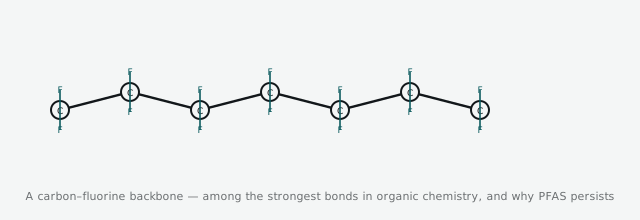
PFAS — per- and polyfluoroalkyl substances — are a family of thousands of synthetic compounds built around carbon–fluorine bonds, among the strongest in organic chemistry. That bond is why they are useful, in non-stick coatings, firefighting foam, stain repellents and food packaging. It is also why they do not meaningfully break down, in the environment or in people.
What EPA regulates today
In April 2024 EPA finalised the first National Primary Drinking Water Regulation for PFAS. It set six enforceable limits:
| Compound | Limit | Status as of September 2026 |
|---|---|---|
| PFOA | 4.0 ppt | Proposed to remain |
| PFOS | 4.0 ppt | Proposed to remain |
| PFHxS | 10 ppt | Proposed for rescission |
| PFNA | 10 ppt | Proposed for rescission |
| HFPO-DA (GenX) | 10 ppt | Proposed for rescission |
| Hazard Index (mixture) | 1 | Proposed for rescission |
Four parts per trillion is the lowest number in the entire drinking water rulebook. For scale, a part per trillion is roughly one drop in twenty Olympic swimming pools.
What changed in May 2026
On 18 May 2026 EPA announced two proposed rules. The first keeps the PFOA and PFOS limits at 4 ppt but proposes letting water systems request two additional years to comply, moving the deadline from 2029 to 2031. The second proposes rescinding the limits for PFHxS, PFNA, GenX and the Hazard Index, on the argument that the 2024 rule did not follow the Safe Drinking Water Act's statutory process for those four.
Neither proposal is final. As of today the April 2024 rule stands, with all six limits. The proposals are in their comment period. Any site telling you the rules have changed is ahead of the facts — check epa.gov/pfas for the current status before relying on this.
What this means for your household
Very little, and that is the point worth making. Regulatory deadlines govern what your utility must do and when. They do not describe what is in your glass this evening.
Two consequences follow from the revision. If PFHxS, PFNA and GenX lose their limits, utilities are no longer required to treat for them — which makes a filter's Total PFAS claim, covering seven compounds rather than two, more valuable rather than less. And a deadline extension to 2031 means several more years before affected systems must be in compliance.
How to find out whether you have a problem
Under EPA's fifth Unregulated Contaminant Monitoring Rule, public water systems tested for 29 PFAS compounds and lithium between 2023 and 2025. The results are published, searchable by water system, through EPA's UCMR 5 Data Finder. It is the best free source on public water supplies in the country, and hardly anyone knows it exists.
Two caveats. Small systems were sampled less comprehensively than large ones. And like every utility dataset, it describes water leaving the treatment plant — not water arriving at your tap, which has travelled through the distribution network and then your own plumbing. For PFAS that distinction matters less than it does for lead, since PFAS is not picked up from pipes. For lead it is decisive.
What actually removes PFAS
Two technologies, reliably: activated carbon block and reverse osmosis. Granular activated carbon is less effective than a dense block. Standard sediment filters, UV, water softeners and pitcher filters using basic carbon do essentially nothing.
To be certified for a PFAS claim, NSF requires reduction to below 20 parts per trillion. That threshold is worth holding onto: it is higher than EPA's 4 ppt limit for PFOA and PFOS. A certified filter is certified to get you under 20, not under 4.
Of 2,206 product rows certified under NSF/ANSI 53, 83 carry a PFAS claim, held by 14 manufacturers; 13 more hold a PFOA claim at WQA. If you would like to see exactly which, that is what the register is for.