FilterProof

Reference

Contaminant index

22 contaminants: the legal limit, the exact certification claim that covers it — if one exists at all — and the technology that actually removes it.

The column that matters most is “certification claim”. If it says none, no filter on earth can be certified against that contaminant, because the claim does not exist in the standard. Uranium is the clearest example. Any product marketed as certified for it is misusing the word.

PFAS

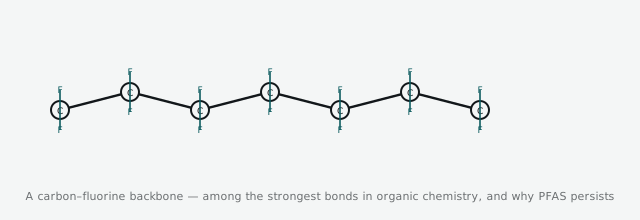
Simplified diagram of a PFAS carbon-fluorine chain: a zigzag of carbon atoms each bonded to fluorine atoms above and below.
Simplified for explanation — not a specific compound's exact structure. The carbon-fluorine bond is why PFAS persists.

PFOA

Certification claim exists

Perfluorooctanoic acid

One of two PFAS compounds EPA regulates at 4 parts per trillion — the lowest figure in the federal drinking water rulebook. EPA describes PFAS generally as persistent, which is why they are found in water supplies long after use stopped.

Where it comes from: Firefighting foam, non-stick coatings, industrial discharge, landfill leachate

4.0 ppt EPA maximum contaminant level, 2024 PFAS rule
Yes Claim: PFOA Reduction under NSF/ANSI 53
2 Activated carbon block · Reverse osmosis

PFOS

Certification claim exists

Perfluorooctane sulfonate

Regulated alongside PFOA at 4 parts per trillion. Largely phased out of US production, yet still detected in water supplies.

Where it comes from: Firefighting foam, stain repellents, metal plating, industrial discharge

4.0 ppt EPA maximum contaminant level, 2024 PFAS rule
Yes Claim: PFOS Reduction under NSF/ANSI 53
2 Activated carbon block · Reverse osmosis

Total PFAS

Certification claim exists

Seven-compound PFAS group

NSF's strongest PFAS claim. Per NSF's own footnote it covers PFHpA, PFHxS, PFNA, PFOA, PFOS, PFBS and PFDA. A filter with this claim has been certified against seven compounds, not two.

Where it comes from: Industrial discharge, firefighting foam, consumer product manufacturing

See individual limits EPA regulates PFOA and PFOS at 4 ppt; PFHxS, PFNA and GenX at 10 ppt
Yes Claim: Total PFAS Reduction under NSF/ANSI 53
2 Activated carbon block · Reverse osmosis

PFHxS

No certification claim exists

Perfluorohexane sulfonic acid

There is no standalone NSF certification claim for PFHxS. The only way a filter is certified against it is inside a Total PFAS claim.

Where it comes from: Firefighting foam, industrial discharge

10 ppt EPA MCL — but EPA proposed rescinding this limit in May 2026
None No product can be certified against this contaminant
2 Activated carbon block · Reverse osmosis

GenX

No certification claim exists

HFPO-DA

Introduced as a replacement for PFOA. No standalone NSF certification claim exists for it.

Where it comes from: Fluoropolymer manufacturing, notably in the Cape Fear River basin, North Carolina

10 ppt EPA MCL — EPA proposed rescinding this limit in May 2026
None No product can be certified against this contaminant
1 Reverse osmosis

Metals

Lead

Certification claim exists

Lead (Pb)

Lead usually enters water inside your own building, after the utility's last test point. That is why a utility report can look clean while your tap is not — and why lead is the one contaminant a home test genuinely settles.

Where it comes from: Lead service lines, brass fixtures, lead solder in household plumbing

15 ppb action level Treatment technique. EPA's maximum contaminant level goal for lead is zero. Action level drops to 10 ppb on 1 November 2027 under the Lead and Copper Rule Improvements
Yes Claim: Lead Reduction under NSF/ANSI 53, NSF/ANSI 58
3 Activated carbon block · Reverse osmosis · Distillation

Arsenic

Certification claim exists

Arsenic

The certification claim only covers pentavalent arsenic (As V) and only up to a stated influent level. Trivalent arsenic (As III) is not covered — which is why arsenic is a contaminant you test for before you buy, not after.

Where it comes from: Natural geology, especially in private wells; historic pesticide use; mining

10 ppb EPA maximum contaminant level
Yes Claim: Arsenic (Pentavalent)<=50 ppb Reduction under NSF/ANSI 53, NSF/ANSI 58
2 Reverse osmosis · Activated alumina

Chromium-6

Certification claim exists

Hexavalent chromium

In NSF's claim list this claim appears under NSF/ANSI 58 only. A carbon filter does not carry it.

Where it comes from: Industrial discharge, natural geology, corrosion inhibitors

100 ppb (total chromium) No separate federal limit for hexavalent chromium; California sets a state MCL
Yes Claim: Chromium (Hexavalent) Reduction under NSF/ANSI 58
1 Reverse osmosis

Mercury

Certification claim exists

Mercury

Well covered by carbon block certification.

Where it comes from: Industrial discharge, natural deposits, landfill runoff

2 ppb EPA maximum contaminant level
Yes Claim: Mercury Reduction under NSF/ANSI 53
2 Activated carbon block · Reverse osmosis

Copper

Certification claim exists

Copper

Like lead, copper is usually picked up inside your own building rather than at the treatment plant.

Where it comes from: Corrosion of copper household plumbing

1.3 mg/L action level Treatment technique under the Lead and Copper Rule
Yes Claim: Copper Reduction under NSF/ANSI 53, NSF/ANSI 58
2 Activated carbon block · Reverse osmosis

Disinfection by-products

Trihalomethanes

Certification claim exists

TTHM

A disinfection by-product: the unavoidable cost of chlorinating water. Levels rise in summer and at the far ends of a distribution network.

Where it comes from: Formed when chlorine reacts with organic matter in the source water

80 ppb EPA maximum contaminant level for total trihalomethanes
Yes Claim: Trihalomethanes (TTHM) Reduction under NSF/ANSI 53, NSF/ANSI 58
2 Activated carbon block · Reverse osmosis

Microbiological

Cysts

Certification claim exists

Giardia and Cryptosporidium

Chlorine-resistant parasites. Certification for cysts is a mechanical filtration claim — the pore size does the work.

Where it comes from: Surface water contaminated by animal or human waste

Treatment technique No numeric MCL; EPA requires removal by treatment
Yes Claim: Cyst Reduction under NSF/ANSI 53, NSF/ANSI 58
2 Activated carbon block · Reverse osmosis

Pesticides

Atrazine

Certification claim exists

Atrazine

Concentrations peak in late spring after application, which annual average reporting can hide.

Where it comes from: Corn and sorghum herbicide runoff — seasonal spikes in the Midwest

3 ppb EPA maximum contaminant level
Yes Claim: Atrazine Reduction under NSF/ANSI 53, NSF/ANSI 58
2 Activated carbon block · Reverse osmosis

Solvents and VOCs

VOCs

Certification claim exists

Volatile organic compounds

NSF's VOC claim is a surrogate: a filter certified for chloroform reduction is deemed to reduce a defined list of other volatile organics.

Where it comes from: Fuel leaks, dry cleaning solvents, industrial sites, degreasers

Varies by compound Benzene 5 ppb, TCE 5 ppb, and so on
Yes Claim: VOC Reduction under NSF/ANSI 53
2 Activated carbon block · Reverse osmosis

Radiological

Radium

Certification claim exists

Radium 226/228

Certified under both the softener standard and the reverse osmosis standard.

Where it comes from: Natural geology, deep wells

5 pCi/L EPA maximum contaminant level, combined
Yes Claim: Radium 226/228 Reduction under NSF/ANSI 44, NSF/ANSI 58
2 Reverse osmosis · Ion exchange

Uranium

No certification claim exists

Uranium

NSF's claim list contains no uranium reduction claim for drinking water treatment units. That means no product can hold an NSF-certified uranium claim, whatever a label says. Reverse osmosis and ion exchange are the technologies usually used against it.

Where it comes from: Natural geology, mining regions, private wells in the western US

30 µg/L EPA maximum contaminant level
None No product can be certified against this contaminant
2 Reverse osmosis · Ion exchange

Other regulated

Nitrate

Certification claim exists

Nitrate / nitrite

A well-water problem above all. Carbon does nothing for nitrate — you need reverse osmosis or ion exchange.

Where it comes from: Agricultural fertiliser runoff, septic systems, manure

10 mg/L EPA maximum contaminant level (as nitrogen)
Yes Claim: Nitrate/Nitrite Reduction under NSF/ANSI 58
2 Reverse osmosis · Ion exchange

Fluoride

Certification claim exists

Fluoride

In NSF's claim list this claim appears under NSF/ANSI 58 only. No carbon filter carries a certified fluoride reduction claim.

Where it comes from: Added by many utilities for dental health; also occurs naturally

4.0 mg/L EPA maximum contaminant level; 2.0 mg/L secondary standard
Yes Claim: Fluoride Reduction under NSF/ANSI 58
3 Reverse osmosis · Distillation · Activated alumina

Emerging compounds

Microplastics

Certification claim exists

Microplastics

Certified under NSF/ANSI 401, the emerging-compounds standard. Unregulated, so there is no legal limit to compare a test result against.

Where it comes from: Degraded plastic waste, synthetic textile fibres, tyre wear

None Not federally regulated in drinking water
Yes Claim: Microplastics Reduction under NSF/ANSI 401
2 Activated carbon block · Reverse osmosis

Taste, odour and scale

Chlorine

Certification claim exists

Free chlorine

The taste most people are reacting to. It sits under the aesthetic standard — which is why a filter can be “NSF certified” and hold no health-effects claim at all.

Where it comes from: Added deliberately by your utility to keep the distribution network safe

4.0 mg/L EPA maximum residual disinfectant level
Yes Claim: Chlorine Reduction under NSF/ANSI 42, NSF/ANSI 53
3 Granular activated carbon · Activated carbon block · KDF / redox media

Chloramine

Certification claim exists

Chloramine

Harder to strip than chlorine and needs more carbon contact time. If your utility uses chloramine, a filter certified only for chlorine is not the same thing.

Where it comes from: Used instead of chlorine by many large utilities because it persists longer in the network

4.0 mg/L EPA maximum residual disinfectant level
Yes Claim: Chloramine Reduction under NSF/ANSI 42
2 Granular activated carbon · Activated carbon block

Hardness

Certification claim exists

Calcium and magnesium

A scale and appliance problem, not a health problem. Handled by a softener under NSF/ANSI 44 — a completely different product from a drinking water filter.

Where it comes from: Dissolved minerals picked up from limestone and chalk geology

None Not a health contaminant; no federal limit
Yes Claim: Hardness Reduction under NSF/ANSI 44
1 Ion exchange

You cannot filter what you have not measured

Every entry above describes what a contaminant is and what removes it. None of it tells you whether it is in your water.

Two things do. Your utility publishes an annual Consumer Confidence Report, which covers the water leaving the plant — useful, free, and blind to everything your own pipes add. And a laboratory test of your own tap, which is the only thing that settles lead, because lead is picked up inside your building, after the utility's last test point.

Start with the register

Once you know what you are dealing with, the certification register tells you which products an accredited body has actually verified against it.

Open the register