Certified vs tested: the sentence that costs you money
Two phrases, near-identical on a box, with entirely different meanings behind them. This is the single most useful thing to understand before you buy a water filter.
Published 12 September 2026 · Checked against the certifiers' own listings
Stand in front of a shelf of water filters and almost every box carries some version of the letters NSF. The packaging is doing something clever: it is using a real organisation's name in two different grammatical constructions that mean very different things, and relying on you not to notice which one you are reading.
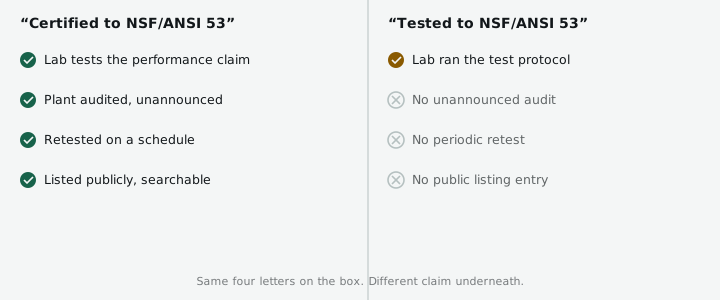
What certification actually involves
When a product is certified to a standard by an accredited body, four things are true:
- The performance claim was verified by testing to a published protocol.
- The manufacturing plant is inspected, unannounced, before and after certification.
- The product is retested periodically — certification is a subscription, not a trophy.
- The product appears in a public listing, with its model number and its exact claims, that anyone can search.
That last point is the one that matters to you. A certification you can look up is a certification. A certification you cannot look up is a sentence.
What “tested to NSF standards” involves
A laboratory ran the test protocol described in the standard. Possibly a very good laboratory, possibly to a high standard, possibly with a result that would have passed certification comfortably.
But there is no unannounced plant audit, no periodic retest, no listing, and no certifier standing behind the claim. If the formulation changes next year, nothing catches it. And crucially: you cannot verify any of it. You are being asked to trust a test report you will never see.
Both phrasings contain the letters NSF. Only one of them is a certification. The difference is invisible at the point of purchase — which is precisely why the phrasing survives.
A worked example, in a company's own words
Epic Water Filters is the honest case, and it is instructive because they explain the distinction themselves rather than hiding behind it. Their own site states that their products are NSF-certified to NSF/ANSI 42 — the aesthetic-effects standard, covering chlorine, taste and odour — and to NSF/ANSI 372, which governs lead content in the materials the product is made from, not lead in your water.
Epic says the contaminant-reduction figures, including the PFAS numbers, come from independent testing to NSF/ANSI 42, 53, 401, P231 and P473 rather than from certification to them. Epic says plainly on their own site that NSF certification and contaminant-reduction performance claims are not the same thing.
That is a genuinely good disclosure. It is also, read carefully, a company telling you that the headline number on the box is not certified. Most brands leave you to work that out.
NSF/ANSI 372 is not a water quality standard
Worth isolating because it is so widely misread. NSF/ANSI 372 certifies that a product's wetted materials are lead-free — that the tap, housing and fittings will not leach lead into your water. It is a plumbing materials standard. It says nothing whatsoever about the filter removing lead that is already in the water.
A product can be certified to NSF/ANSI 372, advertise "certified lead-free", and have no certified lead reduction claim at all. Both statements are true simultaneously. Only one is what you were shopping for.
The five phrases, ranked
- “Certified to NSF/ANSI 53 for PFOA and PFOS reduction” — a specific claim under a specific standard. This is the real thing. Go and look it up.
- “WQA Gold Seal certified” / “IAPMO R&T certified” — equally real. Different accredited certifier, same standards, own public listing.
- “NSF certified”, with no standard named — certified for something. Frequently NSF/ANSI 42, taste and odour. Find out which before assuming.
- “Tested to NSF/ANSI 53” — a lab test, not a certification. Might be excellent. You have no way to know.
- “Tested in an NSF-accredited laboratory” — describes the laboratory, not the product. Contains almost no information about what you are buying.
How to check in about ninety seconds
- Find the exact model number. Not the product family, not the marketing name — the model.
- Search NSF's listing at info.nsf.org/Certified/DWTU/. Search by manufacturer, not brand: the trade-name field is unreliable. Multipure is the clean example — a brand-name search returns nothing, while four Multipure models are certified with PFOA/PFOS claims under the manufacturer name.
- If nothing appears, check WQA at find.wqa.org and IAPMO at pld.iapmo.org. Both are ANSI-accredited and both list independently.
- When you find the product, read the claim list rather than the standard number. “NSF/ANSI 53” is a heading over seventy separate claims. Yours is either on the list or it is not.
Why we built the register
Because that ninety seconds is genuinely difficult. NSF's database is authoritative, current and free — and it is built for manufacturers and regulators, not for someone standing in a kitchen. There is no plain-language search, product-type categories run to over a hundred overlapping options, and nothing translates “I am worried about PFAS” into the right query.
So we did the queries and published the answers. Of 2,206 product rows under NSF/ANSI 53, 83 carry a PFAS claim, held by 14 manufacturers. A further 13 manufacturers hold a PFOA claim at WQA. That is a much shorter list than the marketing suggests — and it took searching two databases, not one, to assemble it.